
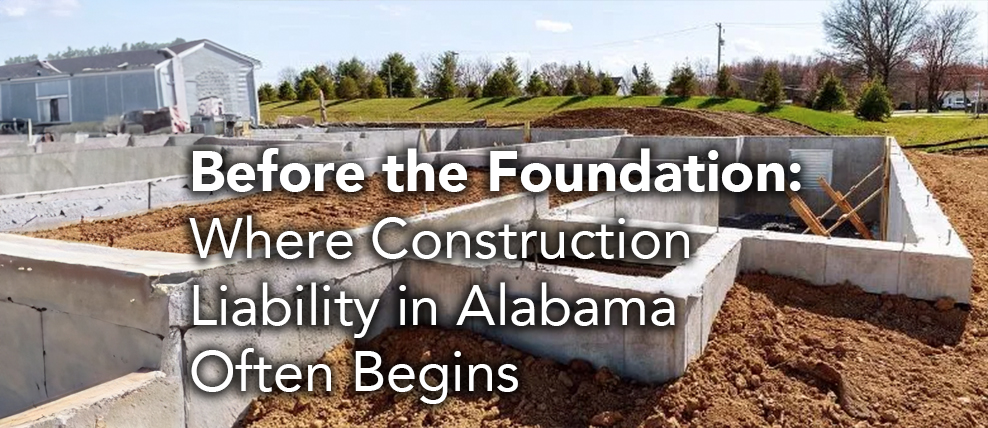
A recent decision from the Supreme Court of Alabama is a timely reminder that drainage issues can become a costly liability for both developers and builders, who are often treated as part of a unified operation when disputes arise. Combined with the reality that construction litigation can drag on for years, unresolved site issues can quickly escalate costs, consume management time, and erode the bottom line. Identifying problems early and working toward a practical resolution before a dispute reaches litigation can save substantial time, legal expense, and years of uncertainty.
In this case, a builder constructed a home on a lot at a higher elevation than a neighboring property. The adjacent homeowner alleged that grading and site changes altered the natural flow of surface water, sending runoff, silt, and debris onto her property and causing structural damage to her home. The builder argued that it neither performed nor controlled the grading or excavation work, but instead relied on a subcontractor. While the trial court granted summary judgment in favor of the builder, the Supreme Court of Alabama never reached the merits of that ruling. Instead, it dismissed the appeal because the underlying judgment was not final. So the builder continues to wait for a final resolution.
In today’s environment, getting the dirt work right matters just as much as the vertical construction. Careful attention to grading, drainage, and erosion control is essential. For anyone in homebuilding, this case reinforces a simple truth that the success, or failure, of a project is often determined long before the first foundation is poured.

Terramoor is a trusted leader in identifying, acquiring, and developing key residential real estate opportunities for homebuilders, investors, and partners. From site selection to final platting, we help unlock a property’s full potential through strategic planning and efficient execution.