
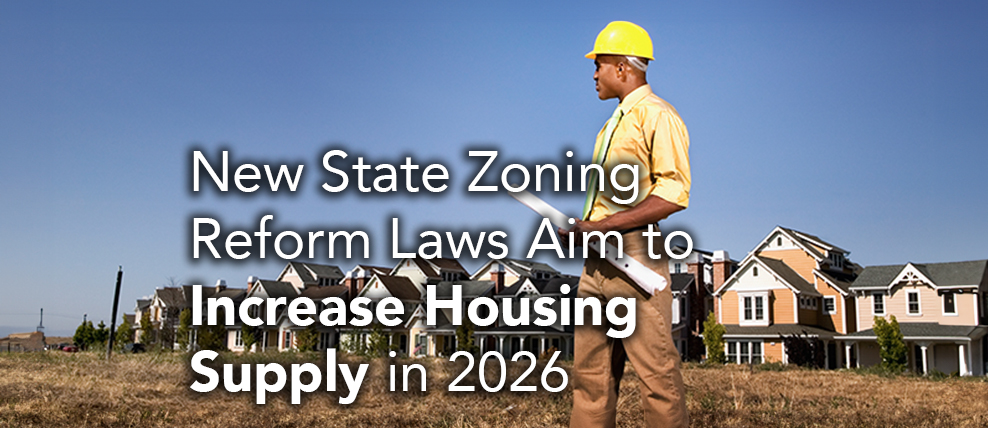
So far in 2026, eight states have put land-use reform on the books. State legislatures have begun rewriting entitlement and permitting laws in order to fix the housing supply problem.
A primary focus has been permitting reform. Georgia’s SB 447 imposes enforceable deadlines on land disturbance permits, while Washington’s HB 2418 similarly streamlines permitting to reduce delays and uncertainty. Kansas’s SB 418 authorizes third-party inspections to prevent stalled projects when government inspections are delayed. It also requires local governments to approve housing developments that comply with existing zoning and land-use regulations without discretionary review by planning commissions.
Indiana’s HB 1001 includes several notable reforms. It requires municipalities to refund certain fees when permit reviews are delayed, protects projects from subsequent zoning changes by applying the regulations in effect when a complete application is submitted, and requires compensation when downzoning reduces property values. Idaho’s Starter Home law, SB 1352, prohibits municipalities from requiring minimum lot sizes larger than 1,500 sq ft in starter home communities. That may be the smallest minimum lot size requirement in the country.
Idaho also passed SB 1354 which prohibits HOAs and municipalities from prohibiting accessory dwelling units (“ADUs”). Virginia passed multiple bills aimed at expanding housing flexibility by allowing ADUs by right in single-family districts, capping ADU permit fees at $500, and requiring qualifying manufactured homes to receive the same zoning treatment as site-built homes.
Other states focused on expanding the land available for housing. Colorado’s HB 26-1001 requires many local governments to allow by-right residential development on qualifying nonprofit, school, transit, and public properties of up to five acres. Minnesota’s SF 1750 prohibits cities from requiring the creation of a homeowners association as a condition of subdivision approval.
While these bills vary in approach, their focus is the same: to increase housing supply by making the development process faster, more predictable, and less costly. It transcends party lines, as both Republican and Democrat controlled states understand that housing supply and affordability are economicissues that directly impact the lives of everyday, hardworking Americans.

Terramoor is a trusted leader in identifying, acquiring, and developing key residential real estate opportunities for homebuilders, investors, and partners. From site selection to final platting, we help unlock a property’s full potential through strategic planning and efficient execution.