
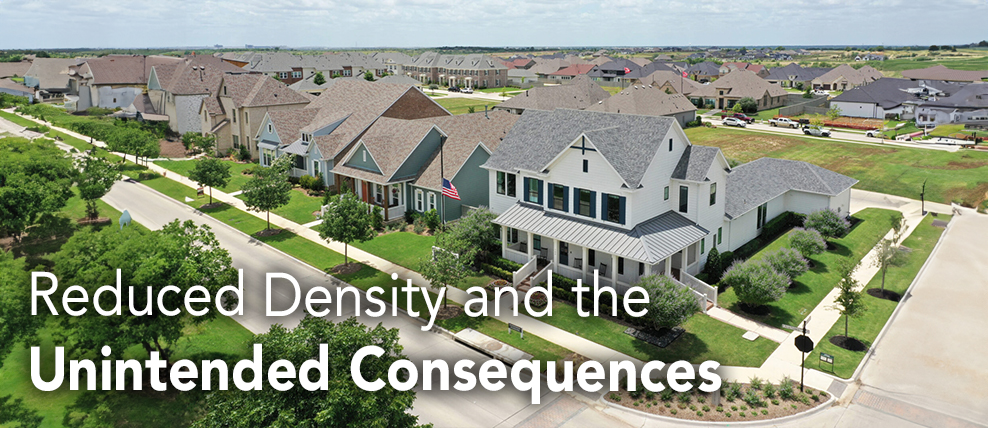
Recently there has been an increase in smaller cities and suburban counties amending their regulations to require large lot sizes—often 15,000 square feet (SF) minimums. The amendments appear to be based on the mistaken belief that larger lot sizes will produce more upscale communities. This is simply not true.
A Real-World Example
A suburban county in the Southeast with a population of just around 100,000 has enjoyed healthy population and economic growth for several years. It is considering implementing a 15,000 SF lot minimum countywide. The simple math shows how a 15,000 SF lot minimum will upend the housing market and stall the community’s economic growth.
The median household income for this county is $75,000. The purchasing power for a $75,000 salary is $225,000-$300,000 home. The average sales price over that last 12 months—$280,000—bore out that purchasing power exactly. The average lot size of those 500 new homes sold last year was about 5,000-7,500 SF.
An experienced residential land developer or homebuilder in that area knows the average sales price and lot size without even looking at the sales data because it all comes down to simple economics. Let’s look at the numbers:
A developer and homebuilder are evaluating a 50-acre tract for a proposed community, GreenAcre. Although the site is 50 acres, topography, roads, utilities, and stormwater detention limit usable land to about 30 acres. To stay within the local purchasing power, the homebuilder must sell homes for no more than $300,000. In the Southeast, most builders target a maximum lot-to-home price ratio of 25%. That ratio caps the lot price at $75,000 for this community. Because of land and development costs, the developer must average four lots per acre to achieve that lot price.
Large Lot Minimums Kill A Municipality’s Growth and Tax Revenue
If the minimum lot size increases to 15,000 SF, or approximately 2 units per acre, then the lot price increases significantly as infrastructure costs (linear feet of water, road, sewer) remain the same regardless of lot size. That $75,000 lot is now well over the 25% lot-to-home ratio. Builders would have to be able to sell homes in GreenAcre for $400,000 +, well over the median purchasing power of the county’s population. With 15,000 SF lot minimums, unless the landowner wants to cut the price of land in half, GreenAcre does not work for the homebuilder, developer, or the homebuyer. And the municipality misses out on the property tax revenue from new homes and the sales tax revenue of new households. Homebuilders don’t build upscale spec homes well above the population’s buying power in the hopes that buyers will magically appear. When the numbers don’t work, homebuilders move to neighboring counties where the numbers do work. And they take the homebuyers and their tax dollars with them.

Terramoor is a trusted leader in identifying, acquiring, and developing key residential real estate opportunities for homebuilders, investors, and partners. From site selection to final platting, we help unlock a property’s full potential through strategic planning and efficient execution.